

Quotidiano d'informazione distribuito in Molise con 
Walk through any casino lobby in 2026 and the front page is a wall of noise. Bonus buys, cascading reels, expanding multiplier ladders, symbols that collect into meters, jackpots stacked four tiers deep. Studios compete on feature count now, and a game without at least three mechanics gets buried by the sort algorithm within a fortnight. Which makes it genuinely strange that a Wazdan title from February 2026 — a game with no free spins round at all — is still sitting there, still getting played, still being searched for by name.
The beach party hot slot survives because it solves a problem the feature arms race created. Not every player wants a game that demands attention. Some want twenty minutes of reels, a soundtrack that sounds like a beach bar, and a balance that goes down slowly enough to be pleasant. That is a real audience, it is badly served by the modern release schedule, and this slot has quietly owned that niche for a decade. This piece explains how it works, who it suits, and where it genuinely falls short.
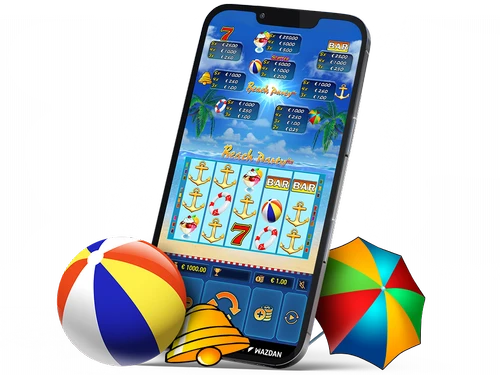
Wazdan released Beach Party Hot on 11 February 2016, in a period when the studio was building out a catalogue of deliberately simple games aimed at players who grew up on land-based fruit machines. The design brief is visible in every decision: five reels, three rows, twenty fixed paylines, and a symbol set of flip-flops, sunglasses, cocktails, seashells, ice creams and a beach ball. No narrative, no characters, no meta-progression.
The RTP is 96.24%, which is above the market average and better than a surprising number of newer, glossier releases. Base volatility is low to medium. Maximum win is 305x your total stake — roughly €30,500 at the €100 top bet, and a figure that looks almost quaint beside modern titles advertising 10,000x or more.
That gap is the point, not an oversight. A 10,000x ceiling has to be paid for somewhere, and it is paid for out of the base game. High-ceiling slots are high-variance slots: long stretches of nothing, punctuated by rare moments that most players never actually reach. Beach Party Hot spends its entire mathematical budget on the opposite priority — frequent, small, steady returns. You will not have a story to tell afterwards. You will still have a balance an hour later.
Whether that trade appeals to you is the single question worth answering before you load it. Everything below is detail.
The paytable splits into the usual two tiers, though with less distance between them than most slots. Beach paraphernalia occupies the higher rungs; the lower end does the filler work. Nothing on the table pays a life-changing multiple, which is consistent with the low-variance design — the money is spread thin and wide rather than concentrated at the top.
The beach ball is the scatter, and it is the one symbol worth watching. It pays from any position on the reels rather than needing to sit on an active payline. In a game with no free spins round, that matters more than it sounds. Scatter-anywhere payments remove the near-miss frustration that makes classic payline slots feel unfair — the sensation of watching three matching symbols land on screen in the wrong rows and count for nothing.
What you will not find: no free spins, no pick-and-click bonus, no wild-driven feature chain, no cascading reels, no multiplier meter, no bonus buy. Some players will close the tab at that sentence. That is a legitimate reaction and it is better to have it now than forty spins in.
Bets run from €0.20 to €100 per spin, one of the wider ranges available on a game this simple. The low end is genuinely low, which matters because the entire appeal here is session length.
Work the numbers before you play rather than after. A €50 bankroll at €2 a spin buys you twenty-five spins on a game designed for hundreds — you have picked a stake that fights the design. The same €50 at €0.20 buys two hundred and fifty spins, and a low-variance slot at two hundred and fifty spins is doing exactly what it was built to do: returning most of your money most of the time, slowly, while you enjoy the noise.
This is the most common mistake players make with this game. They pick a stake that suits a high-variance chase, run dry in fifteen minutes, and conclude the slot is tight. It is not tight. It was configured for a different bet size than the one they chose.
A rough guide: divide your budget by the number of spins you want, and let that decide your stake. If the answer is uncomfortably small, the honest conclusion is that your budget wants a shorter session, not a bigger bet.
Two things sit on top of the base game, and both are player-controlled rather than randomly triggered.
The first is the gamble feature. After any winning spin you can risk the payout on a double-or-nothing, repeatable up to seven consecutive times. Seven correct calls multiplies the original win by 128. A single wrong call at any point takes everything.
The odds are usually clean — a genuine even-money proposition with no house edge baked in, which makes it one of the fairest bets on offer anywhere in a casino. The problem is not mathematical. You chose a low-volatility slot because you wanted a stable balance curve, and the gamble feature is a machine built specifically to destroy stable balance curves. It converts the game into a coin-flip contest at precisely the moment you are feeling good about a result. Enjoy it on small wins if you like the rush; using it on the best hit of your session is the classic way a decent evening ends twenty minutes early.
The second is Wazdan's Volatility Levels, and it is the studio's real contribution to slot design. You can switch the game's variance between low, standard and high at any point, mid-session, without reloading. Low gives you frequent small hits. High thins them out and fattens them up.
The RTP does not change across the three settings. You are reshaping how the same theoretical return is distributed, not unlocking a more generous version of the game. Anybody telling you high volatility "pays more" has misread what the feature does — it pays bigger, less often, for the same long-run total.
Used properly it is genuinely useful. Short session on a small budget, set it low. Longer session with a deeper bankroll and something worth cashing out, set it high. Being able to change your mind halfway through, in the same game, is a level of control most studios still do not offer.
Wazdan has more than one game in this territory, and the names blur together in a lobby search. The original Beach Party is the plainer sibling — same theme, simpler configuration. Hot Party moves the summer motif onto a fruit-machine frame for players who want the aesthetic without the five-reel structure.
Beach Party Hot is the middle option and, for most players, the right one of the three: enough structure to sustain a longer session, few enough moving parts that nothing needs learning. If you have played one and found it thin, the others will not fix that. They are variations on a single idea rather than an escalating series.
Wazdan built this for phones as much as desktops, and it shows. The grid stays readable on a small screen, and two settings deserve specific mention.
Energy Saving Mode strips back animation to preserve battery — practical on a long journey away from a charger. Ultra Fast Mode accelerates spin resolution.
That second one carries a warning that applies to every slot with a speed setting. Faster spins do not change the RTP by a single basis point. They do change how many spins you make per hour, and therefore how much you wager per hour, and therefore your expected hourly loss. Double the spin rate and you have doubled the cost of an hour's entertainment without improving your odds at all. Slower is not a worse game. It is a cheaper one.
| Category | Score | Comment |
|---|---|---|
| RTP | 8.5 / 10 | 96.24% beats the average — confirm the build in your casino's info screen |
| Bonus features | 4.0 / 10 | Scatter-anywhere pays and a gamble. No free spins round exists |
| Session value | 8.5 / 10 | Low variance and a €0.20 floor make small bankrolls last |
| Player controls | 9.0 / 10 | Volatility Levels is a genuinely good idea, well implemented |
| Win ceiling | 4.5 / 10 | 305x is modest against anything released in the last five years |
| Visuals & sound | 6.5 / 10 | Dated, clean, cheerful. The soundtrack does most of the work |
| Mobile build | 8.0 / 10 | Light, fast, fully featured on a phone |
| Overall | 7.0 / 10 | A specialist game that does its one job properly |
Does Beach Party Hot have a free spins round?
No. There is no free spins feature, no pick bonus and no bonus buy. The extras are the beach ball scatter, which pays from any position, and an optional gamble after a winning spin.
What is the RTP?
96.24% in the standard configuration. Wazdan supplies operators with alternative RTP builds, so check the in-game information screen at your casino before betting real money.
What is the maximum win?
305x your total stake, which comes to around €30,500 at the €100 maximum bet.
Can I change the volatility myself?
Yes. Volatility Levels lets you switch between low, standard and high mid-session. The RTP stays identical across all three settings.
What stake should I play at?
Divide your session budget by the number of spins you want. On a low-variance game, more spins at a smaller stake almost always produces a better experience than fewer spins at a larger one.
Is the gamble feature worth using?
The odds are fair, but it works directly against the reason you chose this slot. Small wins only, if at all.
Is there a free demo?
Yes, and it runs the same maths as the real-money version. Fifteen minutes in demo mode will tell you whether the pacing suits you better than any review can.
Who is this game actually for?
Players who want a long, low-pressure session on a modest budget. Anyone hunting four-figure multipliers should look elsewhere and will not be disappointed by the alternatives.





 Termoli, non rispetta lo stop all’incrocio e travolge una Skoda Octavia della Polizia stradale
  «Bosco Corundoli è in serio pericolo»
  Fanelli accusa sul Recovery: Regione in ritardo, dove sono le proposte?
  Tir nella scarpata, lunedì l’autopsia sul corpo del 42enne
  Campobasso, ragazzina aggredita e picchiata: denunciato un 19enne romeno